Publications
A complete up-to-date list of publications of Robert can be found on and full-texts might be available from the .
Collaboration lead by Pasquale Innominato
In this international observational study including two independent cohorts of patients with advanced cancers, an objective measure of circadian function was significantly associated with symptoms鈥� score severity and health-related quality of life. Circadian rest-activity pattern monitoring through wearable devices provides a reliable, consistent and continuous biomarker that identifies several psychosocial dimensions.
Mitochondrial fission-fusion dynamics and mitochondrial bioenergetics, including oxidative phosphorylation and generation of ATP, are strongly clock controlled. Here we show that these circadian oscillations depend on circadian modification of dynamin-related protein 1 (DRP1), a key mediator of mitochondrial fission. We used a combination of in vitro and in vivo models, including human skin fibroblasts and DRP1-deficient or clock-deficient mice, to show that these dynamics are clock controlled via circadian regulation of DRP1. Genetic or pharmacological abrogation of DRP1 activity abolished circadian network dynamics and mitochondrial respiratory activity and eliminated circadian ATP production. Pharmacological silencing of pathways regulating circadian metabolism and mitochondrial function (e.g., sirtuins, AMPK) also altered DRP1 phosphorylation, and abrogation of DRP1 activity impaired circadian function. Our findings provide new insight into the crosstalk between the mitochondrial network and circadian cycles.
First collaboration manuscript between 糖心TV and Paris
Everolimus (EV), a rapamycin analogue mTOR inhibitor, is used in the clinic to treat Estrogen positive (ER+) breast cancer in order to avoid the resistance to hormonotherapy. Here, we investigate if EV has different effects dependent on time of administration.
| A new publication on a slightly more zoological topic: “The Bear Circadian Clock Doesn’t “Sleep” in Hibernation” in Frontiers of Zoology. The paper from lead author Heiko Jansen extends out knowledge on the responsiveness of the circadian clock during “hibernation” in bears. Even in torpid animals housed in constant conditions the clock remains responsive to stimuli light light. It also shows that bear fibroblasts grow really well in culture and human Bmal1 reporter constructs are useful to study their cellular clocks. |
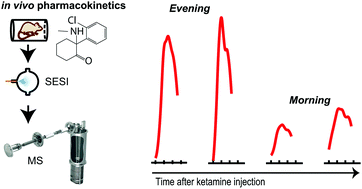
P. Martinez-Lozano Sinues, M. Kohler, S. A. Brown, R. Zenobi and R. Dallmann
Chemical Communications, DOI: 10.1039/C6CC09061C