

漏 Wikipedia Commons
Forward! Don鈥檛 Forget!: Review of Kuhle Wampe oder Wem geh枚rt die Welt? (1932)
, YA author of and
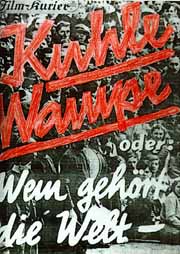
Kuhle Wampe oder Wem geh枚rt die Welt? (1932) is a masterpiece of Weimar cinema that combines excellence in writing, direction, and musical accompaniment, all working together with factory-line precision to offer a glimpse into proletariat Berlin. The key to the film鈥檚 brilliance lies with the collective of artists who created it: the writing team of Bertolt Brecht and Ernst Ottwald, director Slatan Dudow, and composer Hanns Eisler.
These core creatives鈥攁nd Communist supporters鈥攑resent a city whose residents are suffering after years of hyperinflation, unemployment, and political strife. They waste no time getting their political point across. The suffering, already clear in the initial montage of tenements and factories, only mounts as headlines flying by feature growing unemployment numbers. The film then shifts to a more human focus on the impatient gaggle of young people waiting for the release of the job ads before setting off to the locations of the listings on their bicycles, accompanied by frantic, desperate music. Even then, there鈥檚 no respite, as they鈥檙e unfortunately and disappointingly turned away.
Beyond the efforts of the creative team, the acting in the film is also superb. Hertha Thiele, who had already achieved fame in the groundbreaking lesbian cult classic M盲dchen in Uniform (1931), plays the starring role here as Anni, a factory worker whose father and brother are both unemployed. After her brother is driven to suicide by a combination of his own despair and his parents鈥� lack of compassion, the family is subsequently evicted for non-payment of rent. Anni turns to her boyfriend Fritz (Ernst Busch) for help. He invites them out to Kuhle Wampe east of Berlin on the M眉ggelsee鈥攁n actual tent city in operation from 1913 to 1935. The film鈥檚 scenes shot on location鈥攊ncluding the streets of Berlin, the Kuhle Wampe site, and the S-Bahn鈥攁re certainly part of what gives the film its authentic flavor.
But it鈥檚 not all fun and games out at Kuhle Wampe. Fritz gets Anni pregnant, and once she realizes his eventual agreement to become engaged isn鈥檛 voluntary, she turns to other solutions, moving in with her co-worker Gerda (Martha Wolter) and getting more involved in the left-wing workers鈥� movement, thus staking her claim as a revolutionary against those aiming for tyranny and oppression.
The action leads to a sports festival, where the main focus is on the movement of the crowd of young athletes鈥攊ncluding Gerda鈥攑articipating in rowing and other racing events. Eisler鈥檚 music, which accompanied the frenzied pace of the bicyclists at the beginning of the film and turned romantic with 鈥淒as Fr眉hjahr Kommt鈥� at Kuhle Wampe, steals the show here with the 鈥淪olidarit盲tslied鈥濃�攁 catchy earworm with a passionate plea for action that remains in the subconscious long after the film finishes.
The film鈥檚 climactic scene鈥攁 discussion between strangers in a packed car on the S-Bahn鈥攚as directed by Brecht and culminates with the ominous question of who will change the world. A young man points to several older people in the car, saying it won鈥檛 be any of them, but Gerda speaks for herself and her fellow young activists with the response, 鈥淭hose who don鈥檛 like it!鈥�
This highly political film begins with harsh reality and ends with hope, but it unfortunately didn鈥檛 signal the beginning of a mass wave of change these artists desired. Instead, by the time of the film鈥檚 release in May 1932, the Weimar Republic already lay on its deathbed. Once the Nazis came to power in 1933, Kuhle Wampewas at the top of the list of films banned and withdrawn.
Most of those involved with the film left Germany, including Dudow, Brecht, Eisler, and Thiele. A notable exception is the actress who played Gerda. Martha Wolter stayed in Berlin and became a member of the Red Orchestra resistance group with her husband Walter Husemann. After the couple鈥檚 arrest in 1942, Walter was executed in Pl枚tzensee prison. Martha remained imprisoned until liberated by the Red Army in 1945鈥攈aving at least done her part to try to change the world.