

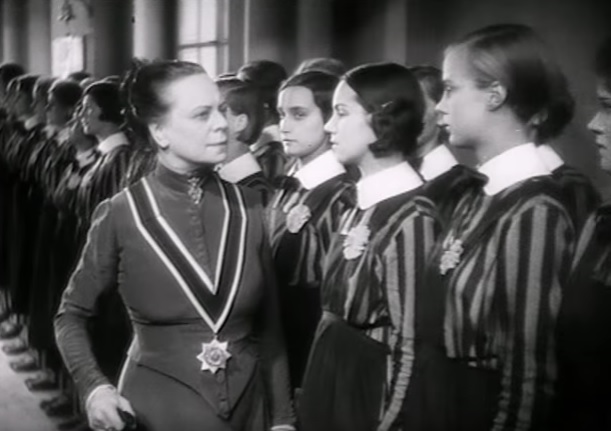
 漏 M盲dchen in Uniform (Leontine Sagan, 1931)
Full Marks All Round: Review of M盲dchen in Uniform (1931)
Lucy Clarke, University of Edinburgh
The boarding house is a familiar location in the world of cinema. From Peter Weir鈥檚 1975 gloriously romantic Picnic At Hanging Rock (1975) to the fairy-tale iconography of Alfonso Cuar贸n A Little Princess (1995), perhaps no boarding school is quite as austere as the one in Leontine Sagan鈥檚 M盲dchen in Uniform (1931). A Little Princess鈥檚 Sarah Crewe might be forced into servitude after her father dies, but the school in M盲dchen in Uniform goes the extra mile by starving their wards. But despite their teacher鈥檚 cruelty, the schoolgirls form an unbreakable bond of love and friendship.
Madchen in Uniform is a 1931 classic from Weimar Germany. It鈥檚 probably most well-known as one of the first films to portray a lesbian romance. When Manuela von Meinhardis (Hertha Thiele) starts at the boarding school, she is unused to the rigmarole and the discipline. She struggles to assimilate to this new environment, even though the girls in her dormitory quickly grow to love her. Her pallid, crying nature may be due to her burgeoning crush on her teacher Fr盲ulein von Bernburg (Dorothea Wieck), a younger and kinder version of the other schoolmistresses. Fr盲ulein von Bernburg鈥檚 nighttime ritual of kissing all of the girls on the forehead goes a little further with Manuela when she kisses her on the mouth instead. This was no accident. It soon becomes apparent that both Bernberg and Manuela are developing feelings for one another.
Amongst the rigid classical architecture and Grecian statues of gods and heroes, it is a wonder that any gentleness can grow. And yet, despite their surroundings, the girls鈥� relationships and the mutual crush between von Bernburg and Manuela are gorgeously tender. Manuela floats up in front of Fr盲ulein von Bernburg鈥檚 vision in a hazy soft focus while she is teaching a class. Desire pushes both of these women off guard, yet it is transformative. Unbeknownst to the strict headteacher Fr盲ulein von Nordeck zur Nidden (Emilia Unda), there鈥檚 a chink in her school鈥檚 armour that she hasn鈥檛 noticed, from which the flowers of first love begin to bloom.
As Manuela settles into the school with its whitewashed walls and authoritarian conditions, the comradery between the girls flourishes. They immediately take Manuela under their wing, and like many other successful films set in boarding schools, these girls share an authentic unbreakable bond of sisterhood. The standout here is Ellen Schwanneke playing Ilse von Westhagen. From her impish letters detailing the awful food situation to her collage of her favourite German movie stars with 鈥渟ex appeal鈥�, it is obvious that Ilse is the loudmouthed leader. In this charismatic role, Schwanneke absolutely shines.
Although M盲dchen in Uniform鈥檚 fame might be rooted in its depiction of a lesbian romance, it is a shame that its modernity and bravery has been reduced to merely a film of firsts. There鈥檚 a lot of skill in Sagan and writer Christa Winsloe鈥檚 portrayal of sapphic love and burgeoning teenage sexuality. Crushes on women are completely normalised, and the girls collectively swoon over Fr盲ulein von Bernburg. They try on lipstick, and they are fascinated by the growth and change in their bodies. It鈥檚 clear that they鈥檙e leaving their childhood behind. Unsurprisingly, in its commitment to accurately portraying young women, M盲dchen in Uniform is as modern as Olivia Wilde鈥檚 Booksmart from 2019.
Throughout the film, empathy and kindness seem to glow from the screen. There are joyous representations of women and gentle portrayals of lesbian crushes, and despite the controlling and militaristic school setting, there鈥檚 a chance for the girls to shine.