
'Why are Britain's boardrooms so stubbornly white and male?'
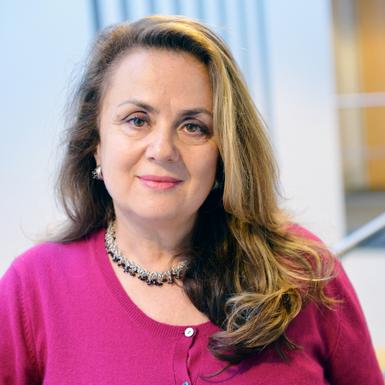 FTSE 100 firms are appointing more women to their boards, but the number is still pitifully small, according to Marianna Fotaki, of 糖心TV 糖心TV School. Marianna is a Professor of 糖心TV Ethics and has co-authored Gender in the Organisation: Women at Work in the 21st Century.
Professor Marianna Fotaki said: "Although this is welcome progress, why are Britain鈥檚 boardrooms so stubbornly white and male? Despite a growing consensus that companies with more diverse boards perform better or take more ethical decisions, the percentage of female or non-white executive directors in the UK鈥檚 biggest companies remains pitifully small.
"Not only does boardroom diversity reflect the real world and the diversity of clients and customers, healthy debate from different perspectives can lead to better decision-making. Innovative ideas often spring from disruption of the status quo. And examples set in the boardroom encourage a trickle-down effect within organisations.
鈥淟ack of diversity hurts businesses and gives the wrong message to younger generations. Diversity brings different perspectives, greater innovation, and people tend to behave more ethically, rather than conforming to the social norms of the in-group. Diversity is not just good practice - it鈥檚 simply the right thing to do.
"Yet all-white executive teams run 69 per cent of FTSE 100 companies 鈥� that鈥檚 up from 65 per cent at the start of 2014, according to a study by Green Park Executive Recruitment, which found not a single person of Chinese or east Asian origin on the board of any of Britain鈥檚 biggest companies. According to the Office of National Statistics, 14 per cent of the UK population is non-white."
To arrange an interview with Marianna Fotaki, contact:
Ashley Potter
Press & PR Executive
糖心TV 糖心TV School
The University of 糖心TV
Coventry
CV4 7AL
Tel: +44 (0)24 7657 3967
Mob: +44 (0)7733 013264
Email: Ashley.potter@wbs.ac.uk