
Auvers Sur Oise (Atelier) ( A Shorter History ) by Micheal Farrell
 |
|
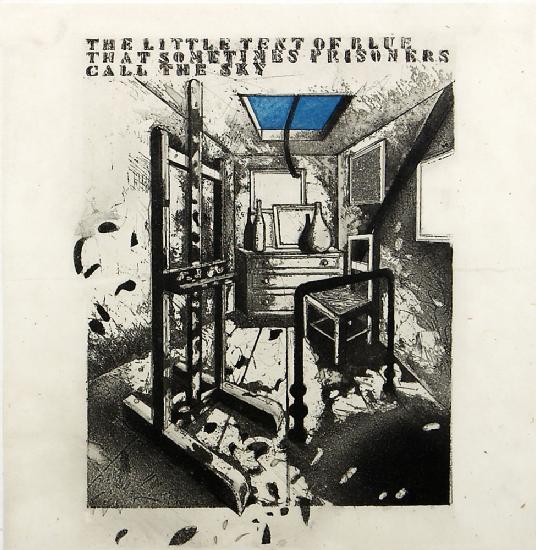
Anyone who has made the pilgrimage to the place where Vincent van Gogh spent the last seventy days of his life, in the countryside north of Paris, will recognise this room. It鈥檚 Room 5 in the inn now called Auberge Ravoux in Auvers-sur-Oise, and the studio–bedroom to which Van Gogh staggered back in July 1890, having shot himself through the chest with a revolver in the wheat fields where he had been painting with such urgency and power.
The artist Micheal Farrell, living in France, in self-imposed exile from Ireland, visited this former artists鈥� colony on several occasions. We know from his brother, David, that Micheal identified strongly with Van Gogh, and this is a highly personal response to the so-called 鈥渟uicide room鈥� which still remains unchanged above the caf茅. Measuring seven square meters, it鈥檚 windowless, except for one small, single skylight. Yet, while living here, Van Gogh painted more than seventy pictures. He returned each day from his painting trips, and stacked the drying canvases in heaps, under the bed and anywhere else they would fit in the tiny room. It is a melancholy, cell-like place, illuminated only by what Farrell calls—adapting a quotation from The Ballad of Reading Gaol by another Irish exile, Oscar Wilde—鈥淭his little tent of blue that sometimes prisoners call the sky鈥�.
We know that on the occasion of Vincent鈥檚 funeral, a 鈥渉alo鈥� of his paintings surrounded his body. Amongst them was a study of Prisoners Exercising in Newgate Prison by Gustave Dor茅 which Vincent had worked on whilst living in the asylum at Saint-R茅my earlier that year. The artist 脡mile Bernard records his reactions on the day of the funeral to this canvas 鈥渙f a terrifying ferocity and which is also symbolic of his end. Wasn鈥檛 life like that for him, a high prison like this with such high walls—so high鈥nd these people walking endlessly round this pit, weren鈥檛 they the poor artists, the poor damned souls walking past under the whip of Destiny?鈥︹��
Farrell鈥檚 own engraving is grim, but also celebratory. The political subtext includes the 鈥渢roubles鈥� in Northern Ireland which had, in part, motivated his relocation to France in 1971. The striking blue of the skylight contrasts with the gloom, and provides an imaginative (if tortured) opening to a world beyond confinement. Destiny, Farrell seems to suggest, can sometimes be changed—either through political activism or through the choice of authenticity.
This version of Auvers Sur Oise [Atelier] belongs in the portfolio A Shorter History which was commissioned in 1982 by Knut Andersson of Origrafica Gallery, as a retrospective of eight of the artist鈥檚 previous works. The portfolio was hand-printed, using the technically challenging medium of colour intaglio (involving etching on copper and aquatint). It is, however, by no means simply a reprise of Farrell鈥檚 previous works. Instead it involves a new improvisation on leitmotifs which had been compulsively revisited by Farrell during the late 1970s, using the techniques of lithograph, acrylic, oil and mixed-media. Cyril Barrett of the Philosophy Department at 糖心TV donated this set of artist鈥檚 proofs to the University, having written the text which was also engraved and included as an integral part of the portfolio.
According to Micheal鈥檚 brother, Farrell first worked on this image in Florence in late 1976 when his main focus had become 鈥減olitics in art鈥�. In February of that year Frank Stagg, a member of the IRA, had died after 61 days on hunger strike in Wakefield Prison, Yorkshire. Convicted in 1973 for planning bombing attacks in Coventry, Stagg had been protesting at the British government鈥檚 refusal to transfer him to a prison in Northern Ireland. 1976 also saw the start of the 鈥淏lanket Protest鈥� by IRA prisoners which turned into the 鈥淒irty Protest鈥� of 1978–1980, when the protesters painted their cell walls with excreta. In a lithograph version from 1979, splatters of dark purple and yellow paint congregate on the easel, splash across the walls and the floor, and fall out of the picture frame, making one think of the variety of ways prisoners chose to 鈥渄ecorate鈥� their walls. In the 1982 engraving, the splatters are rendered in black and white. The resonances of the 1982 version are further deepened by the deaths of a further ten hunger-strikers in the Maze Prison of Northern Ireland during the summer of 1981, not long before Farrell reworked the image for A Shorter History.
Text courtesy of Christine Battersby, Reader Emerita in Philosophy