

From Caligari to RuPaul’s Drag Race: The Maschinenmensch in Pop Culture
Molly Harrabin, University of ÌÇÐÄTV
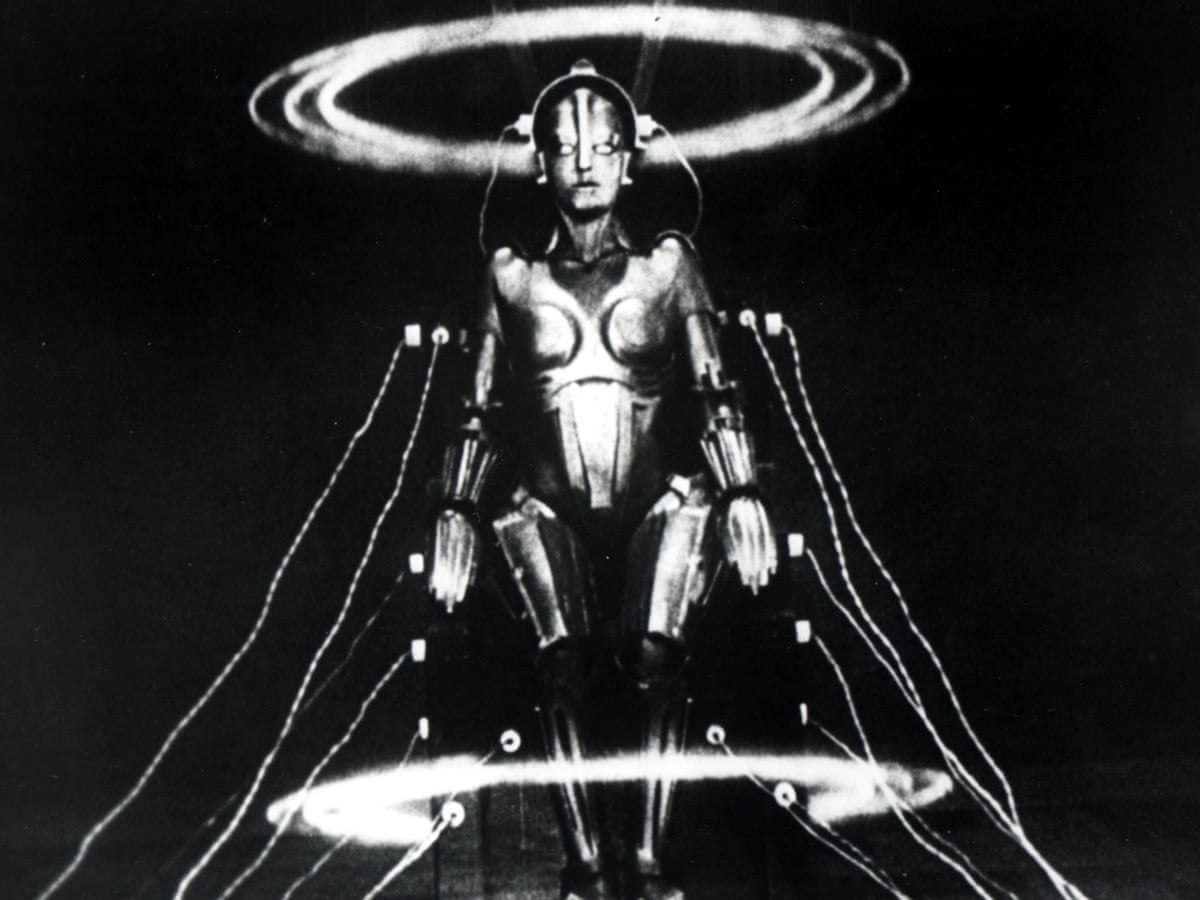
© Fritz Lang, Metropolis, 1927
When Siegfried Kracauer wrote his seminal work, From Caligari to Hitler in 1947, I don’t think he would have expected, 74 years later, the Maschinenmensch from Fritz Lang’s Metropolis (1927) to appear on the main stage of RuPaul’s Drag Race UK. Yet that is what has happened. In the ‘Surprise, Surprise’ runway theme on the second episode of the latest UK series, Rochdale queen Veronica Green stunned the judges with her outfit Ru-veal. Her 1950’s housewife ensemble was dramatically pulled away to showcase a golden robot look that clearly has its inspiration in Lang’s science-fiction classic. This isn’t the first time that we have seen a Metropolis-esque mainstage presentation. Across the Atlantic, fan-favourites Raja (winner of Season 3), Detox (Season 5; All Stars Season 2) and Miz Cracker (Season 10; All Stars 5) have all werked robot Maria designs. This blog post will journey through pop culture, exploring its fascination with Metropolis, focusing on the recurring image of the Maschinenmensch. So, start your engines, and may the best Maschinenmensch win!

© BBC
Our journey begins in 1927, the year in which Metropolis was seen by cinema audiences for the first time. Lang’s most-expensive cinematic production of the period (more than 5 million Reichsmarks) sees the master of the eponymous city, Joh Fredersen (Alfred Abel), turn to his arch-nemesis, the mad scientist Rotwang (Rudolf Klein-Rogge), for help in preventing a workers’ rebellion that would see his capitalist enterprise collapse. The workers’ rebellion is encouraged by Maria (Brigitte Helm), a young woman characterised by her innocence and maternal nature, who assures the workers that a mediator will come to create unity between the working and ruling classes. The catalyst for the uprising comes in the form of Joh’s own son, Freder (Gustav Fröhlich), who, having fallen in love with Maria, believes that he could fulfil the role of the mediator. To thwart the rebellion, Rotwang kidnaps Maria and gives his robotic creation her likeness, using the robot to undo the reputation that the real Maria has created for herself. In doing so, the aim is that the uprising would be prevented. Rotwang, however, does not stick to the plan and instead instructs the robot to cause chaos, an act of revenge against Joh who stole the love of his life from him. The result is total carnage across the whole city, sowing discord amongst the workers which leads to the flooding of the city. Ultimately, the robot is burnt at the stake and the film resolves with hope for the future of Metropolis in its message about the head, hands and heart.
Academics have been virtually unanimous on their interpretations of the function of Maria in Metropolis. It is well-acknowledged that the two versions of Maria represent the tensions in Weimar society regarding the position of women. This is a topic that has attracted attention from scholars of Weimar cinema such as Patrice Petro (1989) and Richard W. McCormick (2001). It is then quite extraordinary that the Maschinenmensch has attracted so much attention in culture produced in contemporary society, for we would like to think that we live in a world where gender stereotypes and expectations are no longer as dominant as they were in the Weimar period. However, Andreas Huyssen (1981) has noted the significance of the intertwining of the female with technology in Metropolis, and it is for this reason, I believe, that the Maschinenmensch continues to be depicted in pop culture moments today. We are simultaneously in awe of the new technologies that are developing, whilst also being somewhat fearful of its implications, and the Maschinenmensch allows directors, musicians and fashion designers to explore that theme in their creations. The Maschinenmensch in Metropolis may have ultimately burnt at the stake as punishment for her crimes, but the legacy of the Maschinenmensch has lived on in pop culture ever since.
 © Wookiepedia

© Instagram: thierrymugler_archives
The fashion industry has also taken notes from Metropolis, with celebrities such as Beyoncé, Kylie Minogue and Lady Gaga all donning the Maschinenmensch guise. In 1995, fashion designer Manfred Thierry Mugler presented his Autumn-Winter collection to the world in Paris. The designer, no stranger to including images of the future in his pieces, looked to the future with reference to the past, showcasing many designs that were reminiscent of the Metropolis Maschinenmensch. To highlight the connection with Lang’s 1927 film further, it was German supermodel, Nadja Auermann, who strutted down the runway dressed in a golden bodysuit. Multiple designers, such as Alexander McQueen, have since followed suit, with the importance of Metropolis and the robot Maria in the fashion community being celebrated by Karl Lagerfeld on the 2010 cover of German Vogue magazine. Though the Metropolis-inspired designs are not necessarily what you might wear when popping to the shops, they demonstrate the fashion industry’s continued homage to Fritz Lang’s classic. © Queen
Where the
Maschinenmensch
has truly taken the world by storm however is in music, with acts such as Madonna taking creative influence from the 1927 film. Madge’s ‘Express Yourself’ (1989) video evokes images from
Metropolis
, with the closing remark of the video bearing great resemblance to the message preached by Maria which comes to fruition at the end of Lang’s film. Madonna’s character, though not physically evocative of the
Maschinenmensch
, carries similar themes to the robot, as the video explores the connection between the machines in the factory and female sexuality. In 1984, Queen achieved worldwide success with their chart-topping song ‘Radio Ga Ga’. The music video includes scenes from
Metropolis
with the band flying over the city in a flying car and Freddie Mercury working the industrial machines, fulfilling the role of Freder. The video directly references the scene in which Rotwang’s
Maschinenmensch
comes to life, but instead of the robot being branded with Maria’s face as is the case in the 1927 film, Queen’s cyborg has the face of Freddie Mercury. The imposition of Mercury’s face on the
Maschinenmensch
contributes to the film’s original discussions on sexuality, by replacing a sexualised woman with a homosexual, the cause of much societal anxiety and paranoia in 1980’s.
© Queen
Where the
Maschinenmensch
has truly taken the world by storm however is in music, with acts such as Madonna taking creative influence from the 1927 film. Madge’s ‘Express Yourself’ (1989) video evokes images from
Metropolis
, with the closing remark of the video bearing great resemblance to the message preached by Maria which comes to fruition at the end of Lang’s film. Madonna’s character, though not physically evocative of the
Maschinenmensch
, carries similar themes to the robot, as the video explores the connection between the machines in the factory and female sexuality. In 1984, Queen achieved worldwide success with their chart-topping song ‘Radio Ga Ga’. The music video includes scenes from
Metropolis
with the band flying over the city in a flying car and Freddie Mercury working the industrial machines, fulfilling the role of Freder. The video directly references the scene in which Rotwang’s
Maschinenmensch
comes to life, but instead of the robot being branded with Maria’s face as is the case in the 1927 film, Queen’s cyborg has the face of Freddie Mercury. The imposition of Mercury’s face on the
Maschinenmensch
contributes to the film’s original discussions on sexuality, by replacing a sexualised woman with a homosexual, the cause of much societal anxiety and paranoia in 1980’s.
 © Wikipedia
More recently, the Metropolis cyborg theme has been adopted by American singer-songwriter, Janelle Monáe. Monáe has released four concept albums based around Metropolis: Metropolis: Suite 1 (The Chase) in 2007, The ArchAndroid: Suites II and III in 2009 and The Electric Lady (2013). These albums follow the story of Monáe’s alter-ego Cindi Mayweather, an android who falls in love with a human, an act for which she is punished by the robotic equivalent of death: disassembly. The second and third suites sees Cindi return to Metropolis via time travel, in an attempt to liberate its citizens from the suppressive organisation in control. Monáe has taken Fritz Lang’s story of an underground rebellion and transposed it onto her own life, telling the tale of rebellion and the fight for freedom and casting light on the experience of ‘others’ in our own society. Janelle Monáe’s Metropolis suite can then be understood as using the Maschinenmensch to present a reflection of what it means to be female, queer and black in 21st century America.
The impact that Fritz Lang’s Maschinenmensch has had on popular culture is undeniable. From influencing one of the greatest science-fiction cinematic outputs of all time, to providing a medium through which notions of sexuality, gender and race can be explored, Metropolis has certainly made its mark. Perhaps what makes the image of the Maschinenmensch so powerful is that it consistently is used to represent the epitome of societal anxieties. For this reason, pop culture continues to incorporate the Maschinenmensch, embracing her like you would an old friend, and I’m positive that it won’t be long before we are reunited once more.
Works Consulted
Beckerman, Jim, ‘Game Changers: ‘Metropolis’, how 1927’s ‘world of tomorrow’ changed pop culture today’, <> [accessed 11 February 2021]
Elsaesser, Thomas, Metropolis (London: British Film Institute Publishing, 2000)
Gunning, Tom, ‘Metropolis: The Dance of Death: The Allegory of the Machine’. The Films of Fritz Lang: Allegories of Vision and Modernity (London: British Film Institute, 2000), pp. 52-83
Huyssen, Andreas, ‘The Vamp and the Machine: Technology and Sexuality in Fritz Lang’s Metropolis’, New German Critique, 24/25 (1981-2) 221-237
Jones, Cassandra L., ‘"Tryna Free Kansas City”: The Revolution of Janelle Monáe as Digital Griot’, Frontiers: A Journal of Women Studies, 39 (2018), 42 - 72
Klimenti, Edena, ‘Re-Vamp: ‘Metropolis 1927’ continues to influence popular culture, [accessed 11 February 2021}
Kracauer, Siegfried, From Caligari to Hitler: A Psychological History of the German Film, ed. and trans. by Leonardo Quaresima (Princeton, New Jersey/Oxford: Princeton University Press, 2004)
McCormick, Richard W., Gender and Sexuality in Weimar Modernity: Film, Literature and ‘New Objectivity’(New York: Palgrave, 2001).
Petro, Patrice, Joyless Streets: Women and Melodramatic Representation in Weimar Germany (Princeton: Princeton University Press, 1989)
Pulliam-Moore, Charles, ‘From Metropolis to Dirty Computer: A Guide to Janelle Monáe’s Time-Traveling Musical Odyssey’, [accessed 11 February 2021]
Sandifer, Elizabeth, ‘A Short Guide to Janelle Monáe and the Metropolis Saga’, < > [accessed 11 February 2021)
Seamer, Connie, ‘A Look at the World Of… Janelle Monae’s Metropolis Series’, [accessed 11 February 2021)
Szaniawska, Alexsandra, ‘Gestural Refusals, Embodied Flights: Monáe’s Vision of Black Queer Futurity’, Black Scholar, 49 (2019), 35 – 50
Young, Bryan, ‘The Cinema Behind Star Wars: Metropolis’, < > [accessed 11 February 2021)